
Note
Go to the end to download the full example code.
Excitation function#
This example demonstrates the use of various excitation functions provided by the pymycar.VerticalModels.exitations module. These functions are commonly used to simulate inputs in vertical dynamics models of vehicles.
The following excitation functions are illustrated:
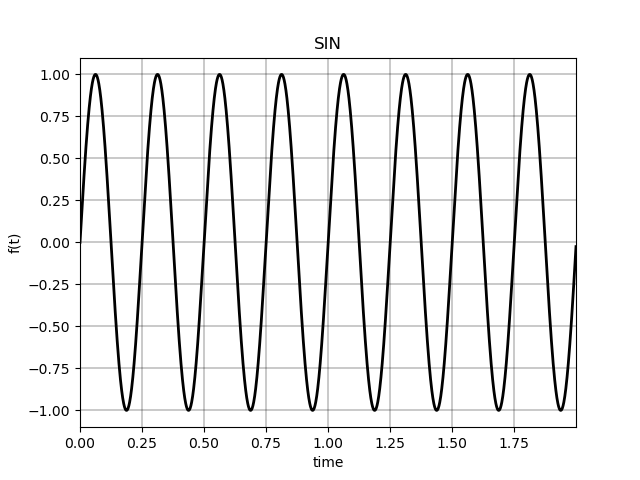
SIN Excitation: A simple sinusoidal excitation function.
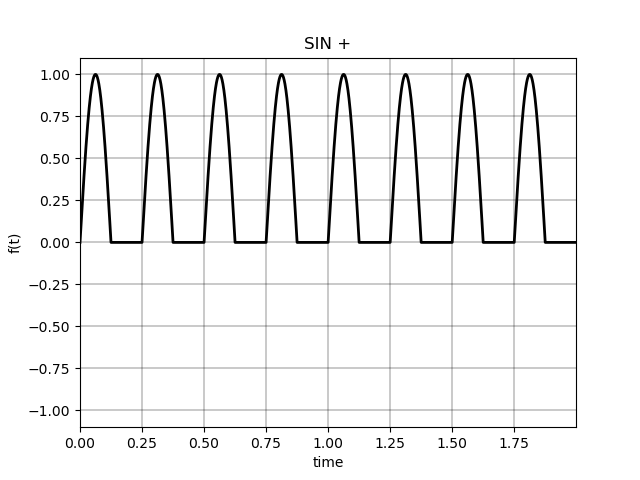
SIN+ Excitation: The positive part of a sinusoidal excitation function.
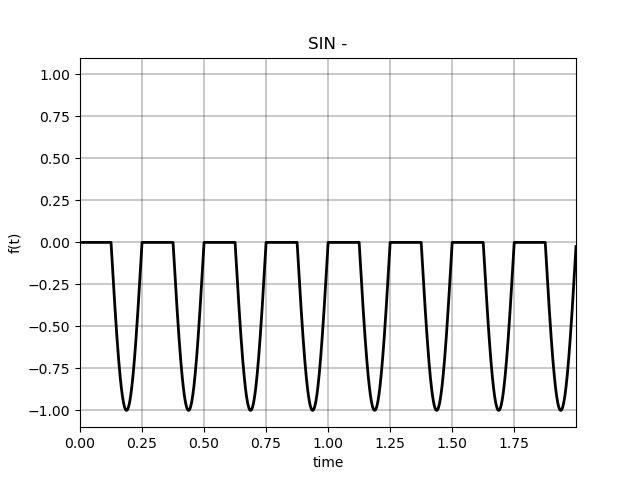
SIN- Excitation: The negative part of a sinusoidal excitation function.
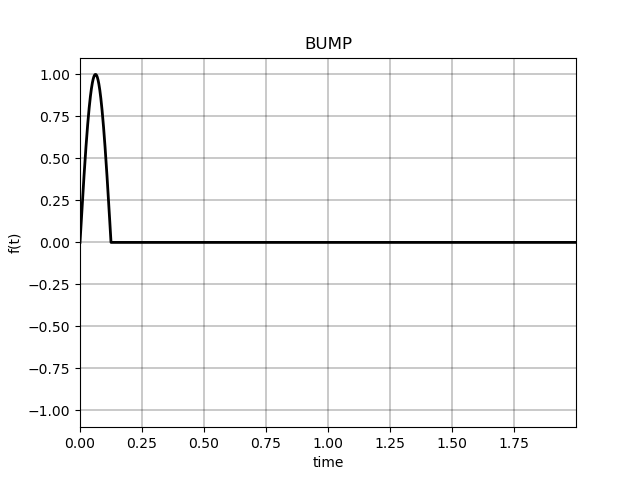
BUMP Excitation: A single bump excitation function.
Each excitation function is plotted over a time interval, demonstrating how the signal evolves.
Import necessary libraries#
import matplotlib.pyplot as plt
import numpy as np
Import from pymycar package#
from pymycar.VerticalModels.exitations import (
    sin_exitation,
    sin_possitive_part_exitation,
    sin_negative_part_exitation,
    bump_exitation,
)

#%
# An amplitude of 1 and a frequency of 4 are used.
amplitude = 1
frequency = 4
t = np.arange(0, 2, 0.001)
SIN excitation function#
Create a subplot for the SIN excitation function
fig, ax_sin = plt.subplots()
ax_sin.plot(t, sin_exitation(t, amplitude, frequency), 'k-', linewidth=2.0)
ax_sin.grid(color='k', linestyle='-', linewidth=0.3)
ax_sin.set_xlabel('time')
ax_sin.set_ylabel('f(t)')
ax_sin.set_title('SIN')
ax_sin.set_xlim(np.min(t), np.max(t))
ax_sin.set_ylim(-amplitude*1.1, amplitude*1.1)
(-1.1, 1.1)
SIN + excitation function#
Create a subplot for the SIN + excitation function
fig, ax_sinposs = plt.subplots()
ax_sinposs.plot(t, sin_possitive_part_exitation(t, amplitude, frequency), 'k-', linewidth=2.0)
ax_sinposs.grid(color='k', linestyle='-', linewidth=0.3)
ax_sinposs.set_xlabel('time')
ax_sinposs.set_ylabel('f(t)')
ax_sinposs.set_title('SIN +')
ax_sinposs.set_xlim(np.min(t), np.max(t))
ax_sinposs.set_ylim(-amplitude*1.1, amplitude*1.1)
(-1.1, 1.1)
SIN - excitation function#
Create a subplot for the SIN - excitation function
fig, ax_sinneg = plt.subplots()
ax_sinneg.plot(t, sin_negative_part_exitation(t, amplitude, frequency), 'k-', linewidth=2.0)
ax_sinneg.grid(color='k', linestyle='-', linewidth=0.3)
ax_sinneg.set_xlabel('time')
ax_sinneg.set_ylabel('f(t)')
ax_sinneg.set_title('SIN -')
ax_sinneg.set_xlim(np.min(t), np.max(t))
ax_sinneg.set_ylim(-amplitude*1.1, amplitude*1.1)
(-1.1, 1.1)
BUMP excitation function#
Create a subplot for the BUMP excitation function
fig, ax_bump = plt.subplots()
ax_bump.plot(t, bump_exitation(t, amplitude, frequency), 'k-', linewidth=2.0)
ax_bump.grid(color='k', linestyle='-', linewidth=0.3)
ax_bump.set_xlabel('time')
ax_bump.set_ylabel('f(t)')
ax_bump.set_title('BUMP')
ax_bump.set_xlim(np.min(t), np.max(t))
ax_bump.set_ylim(-amplitude*1.1, amplitude*1.1)

# Display all the plots
plt.show()
Total running time of the script: (0 minutes 0.214 seconds)